
The Moth Club wasn’t built for 21st-century heat. It survived a planning proposal that threatened its late license, a rare victory for London nightlife. The wooden walls trap the heat making it close and infernal as you near the stage. A crowd old and young united by their homemade haircuts are pulled in from the mild evening to this pressure cooker. In discomfort, in a space whose future has been uncertain against a changing London, there is no better location to celebrate the music of Alan Vega and no better messengers than his contemporaries.
As a solo act and in the duo Suicide, Vega’s work is bookmarked in music history for its unsettling nature. His extremity lay in the sparseness beside his often violent lyrics, layered synths minimal to the point of strangulation. Despite his reputation, particularly that of the track ‘Frankie Teardrop’ memorialised in music criticism as one of the most disturbing tracks ever, he was among the more melodic and accessible of the 1970s no-wave artists. Lydia Lunch (Teenage Jesus and The Jerks) and Marc Hurtado (Etant Donnees) were among the least. They are on stage tonight, 10 years on from his death.
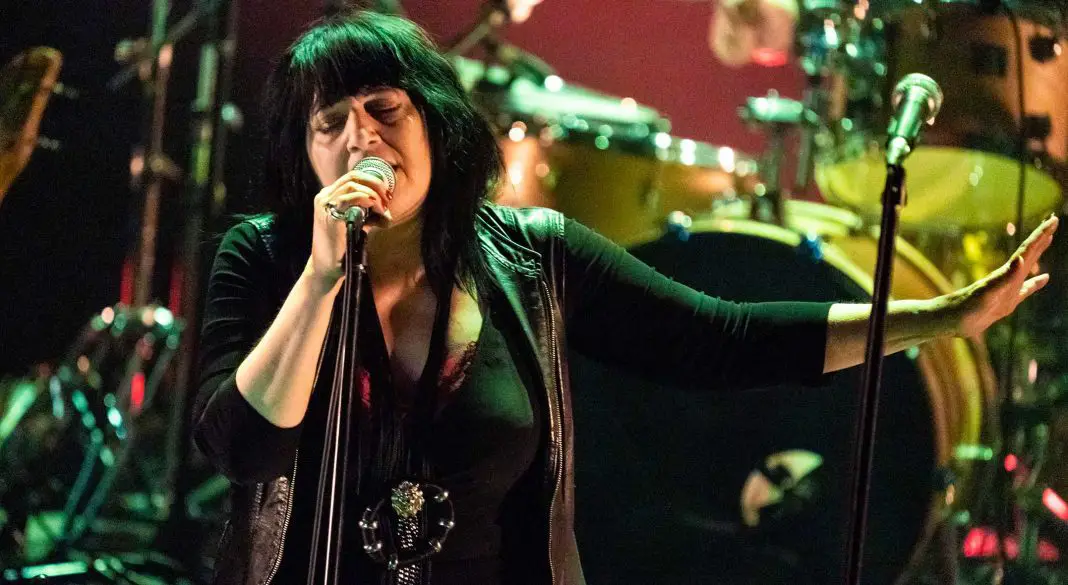
Nearly 50 years on from their debut album, they translate the spaces in his songs into relentless, pulsing noise, Hurtado’s breathy vocals into Lunch’s harsh snarl. He growls beside her, stirring the synths like a mad scientist. Rather than aping Vega’s style they contextualise it in a tradition of boundary-pushing that they are still perpetuating. It is visceral and relentless. I am not alone in glancing at the door, wondering if I need a minute out and if I can handle ‘Frankie Teardrop’ after this. But after the short set is over I am grateful I stayed for the most uncompromising show I have witnessed.
Lydia Lunch stakes her claim to this from the start, telling us it has been 10 years since Alan Vega died and if anyone tries to film she will kill them too. It’s music that would evade an iPhone speaker or drown out a local noise complaint. Some still film surreptitiously; one does so brazenly in the front row and is swatted at like a fly by Lunch. She channels her fury back into the microphone, shouting that ‘Orwell was right’. It turns to a battle with surveillance, Vega’s legacy on her side, before returning for ‘Frankie Teardrop’.
There is no goodbye at the end, she pours herself a whisky, and they both rush to the merchandise stand. It takes a minute for the crowd to realise it’s finished. The lack of comfortable conclusion or gaps between songs mirrors the no-wave movement’s rejection of form or categorisation, not digestible and not exactly fun but resolutely alive. In the absence of photos, I buy a signed poster, almost sheepishly, fulfilling the need for something flat and pretty I could roll up and take home on the tube. But it is a musical principle I could only understand in a live performance, which could only have been fostered in nightlife. A demonstration that the Moth Club’s saviour is a triumph.