
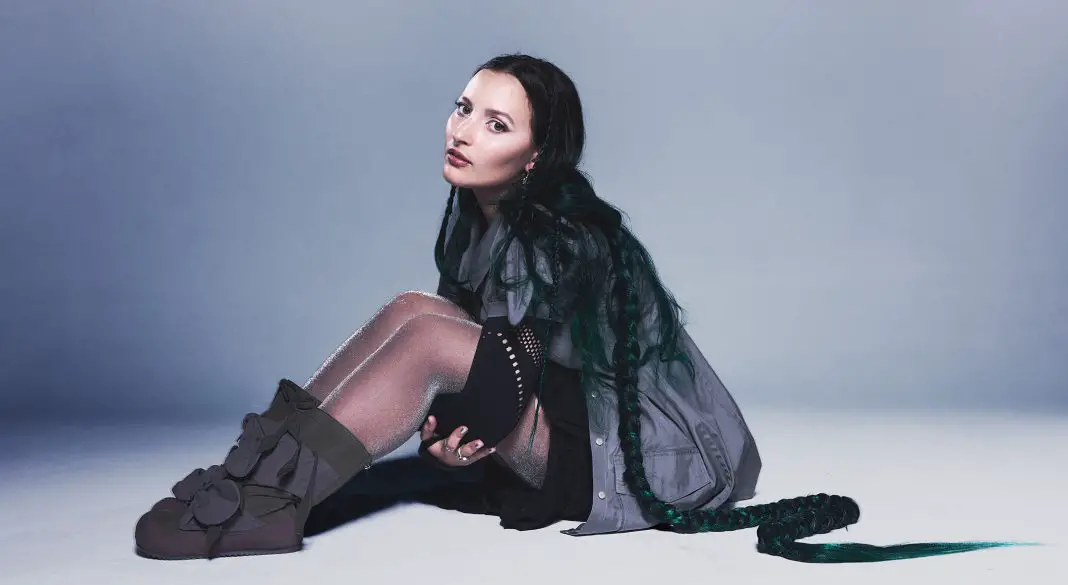
At the peak of their powers, a pop star can often seem like an otherworldly thing: a being operating on a slightly different frequency to the rest of us mere mortals. Under her musical guise of Au/Ra, however, Jamie Lou Stenzel might be the only modern pop girl leaning into the fantasy quite so specifically. She describes the character of Au/Ra as “definitely not human”. Heavily influenced by video games, anime and Lord of the Rings, her music videos are filled with demon slaying and gem collecting in magical lands. Her long-in-the-making debut album ‘Heartcore’ – an electriconic mash-up of hyperpop, Grimes-esque ethereal glitches and a splash of alt-rock – follows a hero’s trajectory, using gaming analogies and parlance to power her back up to life after a harrowing battle.
Au/Ra, the persona, lives in a fictional universe of her own making. But Stenzel, the brain behind it all, has been using imagination and world-building to make sense of earthly reality her whole life. “I was a very weird child and always in my own world anyway, so I just needed to be able to go and escape somewhere,” she considers, calling in from a trip to Oxford. London is now her home, but she was born in Ibiza and raised in Antigua and Barbuda with German heritage. Fantasy was consistent while her identity morphed and grew through it all.
“I grew up feeling quite existential. I used to just stare at myself in the mirror when I was five and be like, ‘Who is that?’ It’s that meme audio – She knew who she was from a very young age… “ Stenzel laughs. “So I’d think, ‘OK, I don’t like this feeling, I’m gonna go play with my Littlest Pet Shop toys for five hours and create my own world’. I’ve always been like this.”
Her first medium of expression was creative writing, and Au/Ra’s name comes from a character she created as part of a Lord of the Rings fan fiction story on Wattpad. “It was wholesome!” she quickly caveats. “When I say fan fiction, it’s not sexy, there was no sexiness to it at all…” Au/Ra back then had red hair; Stenzel is speaking to us sporting long, trademark green locks. The OG character lived in an elvish kingdom; Stenzel has spent the last few years creating an entire “solar punk, fantasy, sci-fi world” for her creation that she is currently working on turning into a larger project in the near future. But the intense creativity and thought behind it all remains the same, from those first moves to the rich, vivid world that now emerges in ‘Heartcore’.
“[At the start], it was purely for the love of fiction and writing. Diving into another creator’s fictional world and expanding on it is really fun, and eventually you start to learn how to create your own based on that, which is where it all started,” she says. “I’ve always spoken through metaphors and world-building, but what was different with this album was, the things happening behind the scenes that these concepts were built on top of, they were all very real…”

Au/Ra’s first taste of fame was as a teenager, when she was thrust into the limelight via a string of unexpected hits. Her own song ‘Panic Room’, released when she was just 16, was a slow-burning viral sensation that reached its apex over Covid, hitting the UK Top 30 and currently standing at over 300 million Spotify streams. A 2018 collaboration, ‘Darkside’, with Norwegian DJ Alan Walker was a more immediate smash, heading straight to Norway’s Number One spot. A CamelPhat remix of ‘Panic Room’ also began doing serious numbers, as did her 2020 collab with Jax Jones, ‘I Miss U’.
Slowly, Au/Ra found herself becoming the sort of artist whose name would be prefixed with ‘featuring’. “I do love dance music and I have a connection to it, even just from my dad [a record producer] where I grew up listening to his music and techno and trance. But it was something I really consciously was trying not to do, which was tricky,” she says. “I didn’t want to become the ‘featured vocalist’ type of artist. That was really important to me. But there was also a period of time where I couldn’t put out original music, so I did a lot of collaborations because it was the only thing I could do.”
Signed at 14 years old, much of ‘Heartcore’’s narrative of overcoming turmoil and recovering from trauma comes from the fall-out of her relationship with an old mentor. She doesn’t go into the details, but refers to it as a “really personal betrayal” that subsequently led to a lengthy legal battle which prohibited her from releasing music under her own solo name for several years. Writing ‘Heartcore’ was an escape and a way to process the trauma (alongside a lot of therapy). “I had no idea when it would be over, which created this weird limbo where I was forced to experiment,” she recalls. “It put me in a headspace where I was like, well, I literally don’t know what else to do right now so I’m just gonna start creating my own inner world again and turn to that.”
Largely a buoyant, giggly conversational presence even when broaching darker subject matter, Stenzel’s tone changes when she talks about the younger girl she was once, and how the industry warped her youth. “Nowadays when I hear, ‘Oh this new, 15-year-old artist…’ I shudder,” she says. “It’s such a weird thing to grow up [in this world] because yes, it’s music and it’s wonderful, but it is still a job. It gives you a completely different teenage-hood. It morphs your reality and I definitely needed to work through a lot of identity issues around Au/Ra and my personal life and being able to separate those in a healthy way.
“I got signed for the first time when I was 14, and that’s ridiculous. I have a 15-year-old sister now and I think: you’re a baby, baby child. You need to stay in school and hang out with your friends because you’ll never get that time back. I do think artists need to unionise or something. There needs to be some checking: how old is this person? Who’s their guardian overseeing everything? Who’s making decisions on the business side or the financial side? There’s so many parts of it that are glossed over and that’s how a lot of young artists end up in bad situations that are irreversible. There are a lot of people who get defeated by these things and honestly, I get it. There was definitely a moment where I thought, ‘Can I do this again?’”
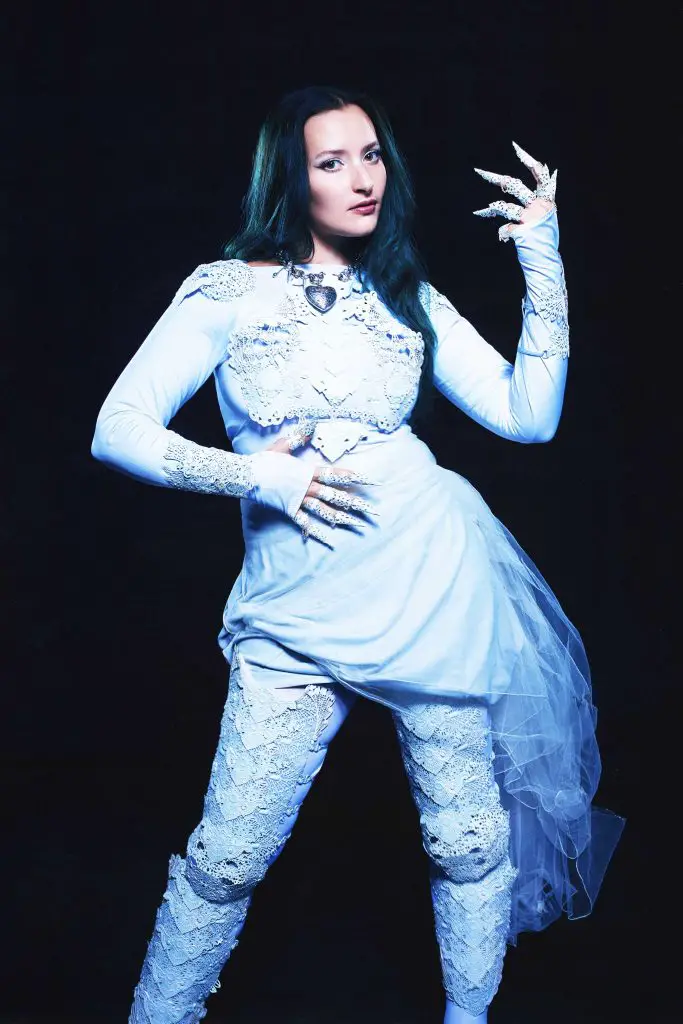
Though the narrative arc of ‘Heartcore’ contains some necessary, unmistakable points of turmoil, from the whispered industrial introduction of ‘THE DESCENT’ to the backstabbing of ‘This Is Character Building’, there’s a defiance and hope to the record as a whole. Even when Au/Ra is at her lowest – down to her last shreds of energy, nearly out for the count – musically, Stenzel is fighting back with the sort of ‘Art Angels’-esque palette that sees vulnerability and grit as bedfellows. The symbol that she created for the record (a creative element that she designs for every release) is a broken heart with a flower growing from its centre. “It [means] that you can grow out of a dark situation. We’re very resilient beings, and beauty really does grow out of the ruins,” she smiles.
‘Heartcore’ ends with its title track, and the parting line “I’d do it all over again”. “The [message] is that you do have the strength within yourself to keep trying,” Stenzel nods. “Your inner world, and the way you treat yourself, is so important so just make sure that you’re being kind to yourself. If this record can help anyone get through a healing journey of their own then that’s incredible and I’ve done my job right.”
‘Heartcore’ is out June 26 2026