

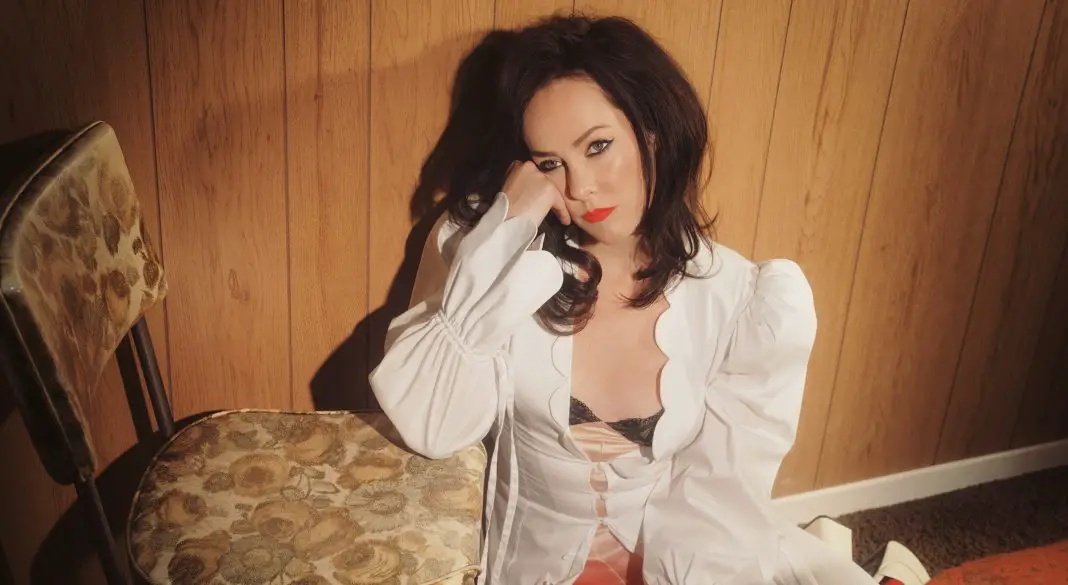
Over the past few decades, the pipeline between actor and musician has become an increasingly busy one. Right now, you can’t move for pop stars – from Charli to Dua to Twigs – taking prime positions on the big screen, meanwhile the opposite trajectory has created some of the world’s biggest artists (Miley Cyrus, Olivia Rodrigo), as well as acclaimed side hustles for some of cinema’s more alternatively-minded stars. Recent awards season sweeper Jessie Buckley released a Mercury Prize-nominated album alongside Bernard Butler back in 2022, while in 2008 Scarlett Johansson put out an album of Tom Waits covers that featured David Bowie on backing vocals.
However, listening to the warped autotune of this month’s debut solo album ‘Flowers For Men’ – a deeply personal yet synthetic sonic niche that she’s dubbing “sci-fi folk” – it’s hard to think of any actor who’s making music quite like Jena Malone. Having long-cemented her Hollywood credentials with starring roles in Donnie Darko, The Hunger Games and, most recently, Love Lies Bleeding, for Malone, music clearly scratches a completely different itch: one where she can stop toeing any semblance of a party line and follow her urges with abandon.
“From when I was 10, I realised that acting was what was going to make me money so I had to be careful. If this is my [career], then I’m not always going to be able to take the risks that I may want to in this space,” she recalls, calling in from her car in “a dilapidated part of Eagle Rock” on the way back from a gym class. “I think that I found music at a time when I had a deep hunger to take risks, and it felt like a space that I could take so many of them in – creatively, narratively, character-wise. If I want to, I can write from the perspective of an 89-year-old man. I can write from the perspective of a fallen leaf.”
The dreamy yet visceral sonic world that Malone exists in came from this risk-taking mentality, too. Having initially written off autotune as something she’d hate (“I think, secretly, there was a child in me that thought I was too cool for it, you know?”), she then found an app that changed her mind completely. “I found this way of using autotune to tell folk stories that felt really intimate and really immediate,” she explains. “The manipulation of the voice becomes how we change character. I can shift pitches and now I’m a man. Now I’m an alien. As you paint with the texture of the voice, it changes the narrative, which I love so much because I just want to tell stories.”
That discovery arrived around a decade ago, when Malone gave birth to her son. Having always written music throughout her life, the way she approached songwriting swiftly had to adapt as soon as she became a mother. Instead of “working for 18 hours a day, just sitting in front of a laptop and probably not eating very well; probably smoking way too much pot”, time became the biggest barrier. “I would sometimes climb into the closet so my son didn’t hear me in the middle of the night and I would record little song ideas,” she says before remembering with a laugh: “There was a lucrative phase of writing all of these poems via my phone while I was taking my son to Disney movies that did not excite me at all. I’d be in movie theatres with my brightness all the way down, and I would just use that as writing time.”
These snatches of creativity yielded a huge number of unfinished songs; Malone estimates that, over that time, her archive probably amounted to around 500 recordings in various states of completion. When her son turned eight, she felt like she finally had the capacity to devote sustained time into turning some of them into an album. And so, with the help of her friend and neighbour Jamie Jackson – an award-winning TV and film composer who’s also worked with Solange – they set about creating the intimate, evocative world of ‘Flowers For Men’.
‘Flowers For Men’ is, Malone admits, a fairly sarcastic title, but it’s also one born of the desire to “find gratitude, and something sacred, and to find a learning [point] that’s not focusing on the toxicity of the patriarchy,” she says. “It was like a writing prompt to myself.”
She describes the record as “an ode to relationship anarchy”. Having spent much of the last decade exploring ethical non-monogamy, polyamory and other non-traditional relationship models, she found these ideas not only permeating her lyrics but her whole world view. “I think, by having experiences that directly say: ‘My learned experience is wrong and now I have to look at everything differently’, it creates this beautiful cognitive dissonance where you’re just like, ‘Oh my god! Now I can question everything because none of it’s true!’” she enthuses. “It’s such a good, curious space.”
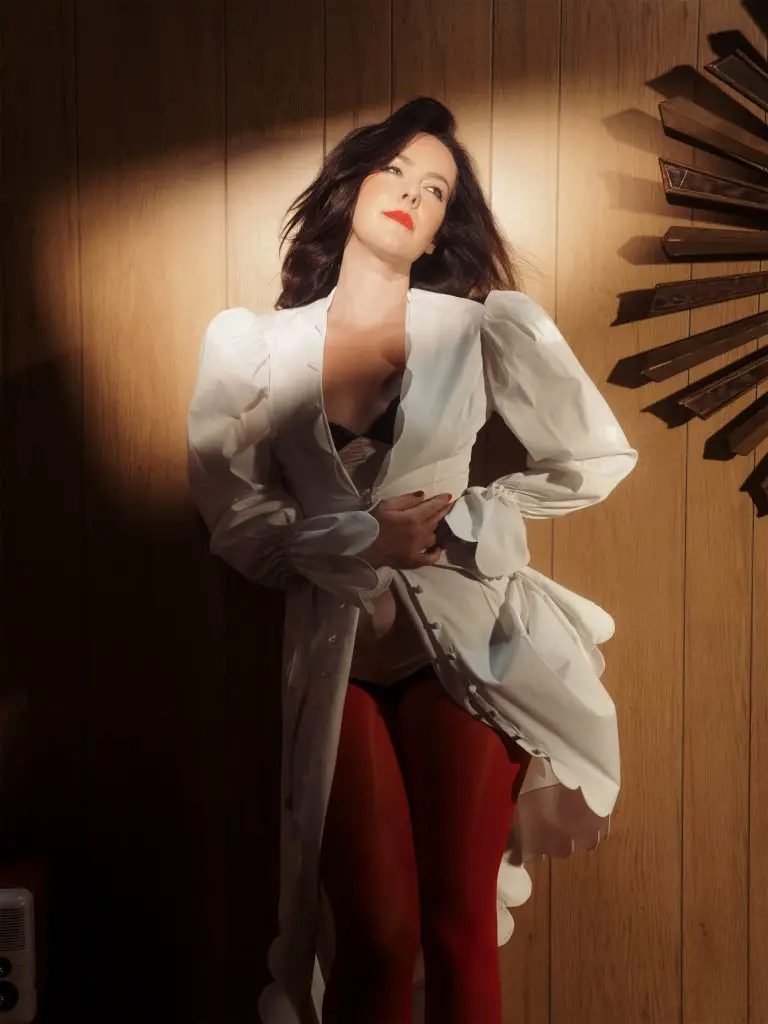
On meditative, reflective lead single ‘Barstow’, Malone travels through its titular highway town, looking back on past versions of herself that were “carefree and contagious” and reclaiming her youthful light. Meanwhile, with the bloody imagery and haunted electronics of ‘Let’s Get Out Now’, she turns the “war zone” of toxic relationships into a lesson on boundaries and prioritising yourself. “I’ve had a very hard time leaving toxic relationships because I always felt like I’m smart, so I can cure it,” she says. “But I lost that ability in parenthood. I no longer have the flexibility to work on other people’s change.”
The “cognitive dissonance” that Malone speaks of is one that’s helped her to refute the happily-ever-after narrative of monogamous romantic love as the only option. “I was often in that romantic limerence of putting your partner above everything else where you sacrifice your time and your career. It’s so backwards but it’s in almost all of the movies and books we read, and no-one was giving me other stories,” she explains. “But motherhood gave me this risk space where I was like, ‘I need to figure this out because I’m going to be loving my son. I’m going to be loving my work. I’m going to have to be loving myself. And none of them are allowed to sink below priority ever again’.”
If all that feels radical, then Malone is advocating for a space where tired old narratives can be questioned freely. It makes sense that she’d call her work “sci-fi folk”: in ‘Flowers For Men’, she’s taking ideas of the heart – tales as old as time – and finding a modern, new place for them to land.
Later this month, she’ll be putting her commercial foot forward once more with a starring role in The Boroughs: the hugely-anticipated new supernatural Netflix drama from Stranger Things creators, The Duffer Brothers. She’s excited for that too (“Sometimes, when you enter into something very big, with precedent, that really creates an energy,” she notes). But now that she’s found a way to balance music, motherhood and Hollywood whilst creating her own risk-taking new lane, Jena Malone isn’t ready to give up any of it any time soon.
‘Flowers For Men’ is out now.