
Chances are, every woman you know has a story about sexual harassment or violence. We all know how frustrating it is to stuff keys between fists, to have no choice but to send ‘I’m home safe’ confirmation texts, and how the justice system continually fails us.
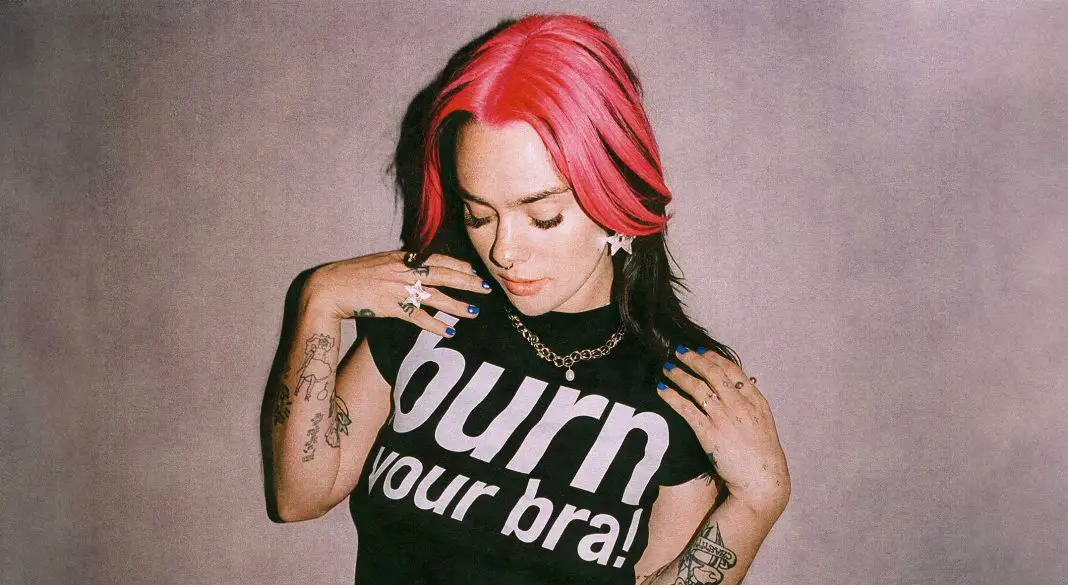
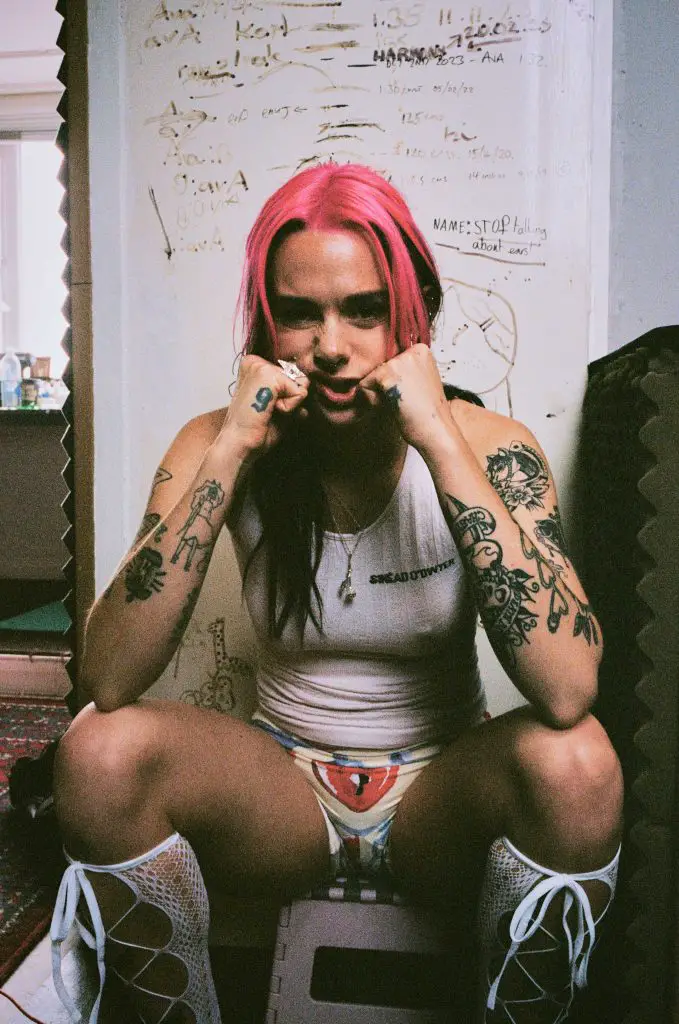
Alt-pop artist girli has been speaking out about sexual harassment for years, both in her real life and her music. Underneath girli is Milly Toomey, who, like many of us, was sexually harassed for the first time as a child in her school uniform. Now an independent artist with a self-cultivated safe and inclusive working environment, she’s never written anything quite as potent with rage and upset as her new single, ‘Slap On The Wrist’.
The track marks the second single from her third album, which is due to arrive in May this year. Sonically, she’s reconnecting with the music she fell in love with as a teenager, and lyrically her stories explore all the shades of love, anger, mess and magic as a queer woman in the 2020s. She tells The Forty-Five what’s to come from album three, and why ‘Slap On The Wrist’ is one of the most important songs she’s ever penned…
When you first started to write for this new album, what were the initial emotions that came up? How did you start to work through those?
“Every time I go to write a new project, I always have an existential crisis where I’m like, ‘Who am I as an artist? What do I write now?’ I definitely had a few months where I was like, ‘OK, I want to keep writing music, but what am I working towards?’ I knew I wanted to make the jump straight into working on a new album; I didn’t want to faff around with the whole EP thing, I’ve done so many of those. I write a lot, so there was going to be no difficulty in writing enough songs for it. There was a real cocktail of emotions; I don’t think I’ve ever written a project that’s just about one thing. The first things I started writing about were being confused about my identity in the world, and then an activist element came into it. ‘Slap On The Wrist’ was actually the last song I wrote.”
How did you start the writing process for ‘Slap On The Wrist’? Was there a realisation in your life where you felt an overriding need to get this anger out?
“It’s always been a topic that’s been relevant to me because, if you’re a woman, you can’t escape it being relevant to you. Every woman and gender minority has faced fear and harassment. I remember being in secondary school and being really involved in trying to spread awareness about sexual harassment even then. But I’d never written a song quite like this. It was the underlying rage, especially just looking at the state of the world. I feel misogyny is getting worse.”
When you were making it, did you find it to be wholly therapeutic, or were there moments that felt more challenging?
“It was really therapeutic. I wrote it with my friend Maude Latour. We were hanging out in LA and I was finishing up some other songs for the album. She was like, ‘We should record a guttural scream, like a rageful or ancestral scream.’ That set the tone and it was really, really fun. It was made by women and queer people. It felt as though all of our collective trauma was just being funnelled into this one thing in a really cathartic way.”
The music video for this song is so impactful. You’ve got images that recreate the locations of where real women were assaulted: in a bedroom, at work, in the park with their child. There is still this outdated idea that women only get assaulted in an alley by someone that they don’t know, and there’s a narrative going around from the far right about ‘protecting women’ and a false idea about who they’re protecting us from. How have you felt watching that unfold over the last few months?
“It’s been insane. Everything that has happened since I wrote the song has made it feel more relevant. One of the things I wanted to bring attention to in the song and the video was to show that sexual assault does not just happen in a dark alleyway by a masked assailant. I’ve experienced, like most women, sexual harassment since I was like… I think the first time I experienced it, I was 12 on the way to school wearing my school uniform. It’s so woven into our lives. It’s obscene that we have to be so expectant of violence every day.
“For the video, I collaborated with my friend Eliza [Hatch] who runs Cheer Up Luv, which is this amazing feminist platform. She had this photo project that started off Cheer Up Luv of survivors in the places where they were assaulted as a form of taking back power, but also showing this happens everywhere. This happens in the day, at the park, it happens to people of all ages, races, sexualities. It happens to pregnant people, it happens to literal children. The media tries to paint this image of the perpetrators as these alien, crazy people. Actually, the people who perpetrate these crimes are everyday men; they’re the person at work, they’re your brother, your dad, your friend, your doctor, your teacher. The far right trying to pin it only on immigrants is just one of the ways where it’s being deflected off the real issue: as a society, we don’t care about violence against women. It’s not prioritised at all.”
When you make your music, you mostly work with women and queer people. Has that always been the case for you? What do you enjoy most about this working environment?
“It hasn’t always been that way – I made it that way. When I was first signed, I was still in my late teens, and my whole team were men. I’d go into big label offices with a whole boardroom of just men and talk to them about my music. My whole life and career changed, because I got dropped from my first label. Then after COVID, I really wanted to do things differently. I want to have more women on my team and more creative control. I want to sing about feminism and queer issues. I didn’t want anyone to tell me that not commercially viable. That experience has been so special, because you should enjoy the process of making music and making art. What’s the point if you’re not? I wanted to do it with people who I would feel safe and comfortable around.”
What do you hope will be the reaction from men when they hear ‘Slap On The Wrist’?
“I hope that listening to this as a cis man would make you realise the amount of suffering that’s going on and the amount of privilege that you have, but also the amount of power you have. The change is going to come from men calling out their friends, their families, [through] education, and making women feel like they have someone fighting their corner who has a lot more privilege than them.”
Going back to the album as a whole, what can fans expect? Is there anything you can tell us about what else is on there?
“I’ve embraced more of an indie rock sound on this album. I grew up going to gigs during the late stage of indie sleaze. I was absolutely in there with my plaid and Doc Martens! That sound has really shaped me. In terms of topics, each album is a window into the period of time when I’ve been making that music. There are some angry songs on there, and there’s some real sweet love songs. There’s a ballad that’s my version of [Chappell Roan’s] ‘Good Luck, Babe’. The whole vibe was to be a bit more authentic. My last album, which I’m so proud of, was all about performance. The visuals and songs were created [within a] world. This one feels a lot more everyday to me.”
What have you learnt about yourself so far through being girli?
“I’ve realised that art and music, in my opinion, is one of the biggest ways to make change. I’ve always been really into activism. I used to want to be a politician, if you can believe it! I think the best way to get into people’s hearts and souls is through creativity. So maybe that’s not even something I’ve learnt about me, maybe that’s just something I’ve learnt about the world, but girli definitely helped me realise that.”