



Lexa Gates
New York breakout Lexa Gates is rewriting the rules of alternative hip-hop, blending sharp-tongued rap with soft, soulful melodies and a hyper-online instinct.
Words: Arusa Qureshi. Photos: Erika Long
Long before the major-label rollout, before the 10-hour performance art piece that led to over 300 million views across social media, before co-signs from SZA, Isaiah Rashad and Clairo, Lexa Gates was a little kid living in Queens, in a house heavy with the burden of tragedy.
“Some wild shit happened in my family,” the Colombian-Puerto Rican artist says frankly. “People died. There was just this emotion in the house.” She was too young to articulate what she was absorbing and didn’t necessarily have the language for mourning, or the vocabulary to ask the kinds of questions adults struggle with themselves. But there was a keyboard in the house – her mother’s keyboard – and that became the place she put everything she couldn’t yet name.
“My mom always wanted to be a singer,” Gates recalls, referencing her mother’s binder filled with CDs and trips with the kids to open mics. But music was more than just background noise; it was a way to process her surroundings.
“I guess I found a way to express what I was feeling from everybody at that time, and I focused on playing the piano. It’s not like I knew the words to say, ‘Oh, this is strange, everybody is mourning. How did this happen?’ That was my introduction to music and to being a composer.”

Fast-forward to 2026, and Gates is quickly building up a reputation as one of New York City’s most exciting new exports, channelling her energy into a straight-talking yet soulful cross-pollination of R&B and rap. Before she was a rapper, though, before she was even consciously writing songs, she was learning how to convert feeling into sound. That instinct – to capture the emotional temperature of a moment exactly as it is – remains the throughline of her work. It has also been at the core of her latest album, ‘I Am’, a project that revels in themes like self-discovery and authenticity. If 2024’s ‘Elite Vessel’ introduced Lexa Gates as a sharpened, hyper-aware major-label presence – controlled, precise, self-contained – ‘I Am’ is the sound of that containment giving way.
“With ‘Elite Vessel’, it felt like I had a corset on,” she says. “And I had people ripping it tight as fuck. And I was like, this is perfect. And then for ‘I Am’, it’s like it kind of just started ripping and I just let myself be how I was. I’m not perfect, and I have problems, so that’s the theme, but I’m always being honest and showing my true self, because we’re all just people.”
I’m not perfect – and I have problems – but I’m always being honest and showing my true self, because we’re all just people
Lexa Gates
That tension – between perfection and personhood, product and human – defines not only the album, but Gates’ rapid evolution over the past several years. In 2020, she released her debut album ‘Order of Events’ under conditions that sound mythic in hindsight – no phone service, no WiFi at home, and no budget for licensing. “I ripped all the beats,” she says matter-of-factly. “ You have to make it happen with whatever you have and however you can.”
She recorded herself in her mom’s basement on GarageBand, packed up her laptop, and uploaded the album via DistroKid from a Dunkin’ Donuts. Then she went home – unable to check reactions, streams, comments. There’s a real vulnerability in putting your music out there for the first time, but even more so when you’re unable to monitor where it’s ending up or who is listening.
“I always thought that if I love what I was doing, so will everyone else,” she says when asked about that period and initial reactions to the music. Gradually, listeners stumbled upon her music, impressed by the sincerity in her easy-going vibe and the overall familiarity in the cadence of her flow. But Gates didn’t wait for validation to continue – she operated on momentum. “I know how this stuff works,” she says. “You just keep going.”

The early EPs – ‘Delirium’, ‘Hungry’ (both 2021) – were made in isolation, soaked in weed smoke and liquor. You can hear it, she admits. The references to Henny (“Sipped a little Henny, I’ll admit I’m buzzed / And more in love with you every day” on ‘Lazy’), the looseness (“Thought about it all the time, lost my mind for it / Spent my days just getting high, going blind for it” on ‘Personal’) and the general sense of someone documenting nights in real time (Stomach growling, crying on the subway / With no way to stop the way I’m feeling / ‘Less I’m higher than a ceiling” on ‘Fun and Games’).
“All of the earlier stuff was very similar; it’s just me in my mom’s basement, recording myself,” she explains. “When it started changing up was with [2022’s] ‘Universe Wrapped In Flesh’ because that’s when I went sober. I really started taking it super seriously, because I did get a lot of positive feedback and people that were showing an interest in what I was doing.”
While her diaristic and nonchalant style of writing remained firmly in place, there was a difference in her overall intention, which went beyond her decision to quit smoking and drinking. For the first time, she also allowed others into her creative space – namely, Toronto producer/writer Quincy Sxbra, who has worked with Yeat and Ziavelli, among others. With positive feedback trickling in and people paying attention, Gates felt a responsibility. “I was like, we got to get this shit done,” she says.
Above all else, there was a willingness to evolve, which set the stage for her major label debut, 2024’s ‘Elite Vessel’. Having signed to Capitol that same year, Gates grabbed hold of the resources available to her, bringing in seasoned producers like Billy Lemos and Black Noise, and eclectic guest spots from artists like Alé Araya on ‘Lately, Nothing’ and Zelooperz on ‘Sweet.. Time’. ‘Elite Vessel’ certainly demonstrates an elevated sound, with rich instrumentation that sits comfortably below her unfiltered rapping about mundane topics, from lovers’ rifts to everyday struggles. On ‘Stacy’s Chips’ for example, chimes and a groove-infused guitar riff wrap tightly around lyrics like “I started doing gel and now my nails are thin and chipped / There’s never any time to cook, I’m eating Stacy’s chips”. There’s an air of polish, also echoed in her attitude at the time and her desire to dream big.
“With that one, I was the elite vessel,” she says. “Anything I had to do, I was there on time. Anything I had to say, I would say it right.” She saw herself as a product – ready to work and level up, personally and professionally. The metaphor became literal in a now-viral 10-hour performance art installation in New York City, where Gates placed herself inside a transparent box, with no food, water, or phone, while the public outside listened to her album. It was a feat of endurance but also a clever marketing stunt – videos on TikTok show passersby stopping to don the headphones placed outside of the box and fans handing her flowers through a slit in the glass as an indifferent Gates looks on, pretending not to be observed. The imagery was blunt but effective and for Gates, it wasn’t merely about spectacle; it was a commentary on visibility, expectation, and the odd pressure of being incessantly watched. She was packaging herself before anyone else could. “They were always telling me to make TikToks,” she says. “So I was like, I’m gonna put myself in a box.”
If ‘Elite Vessel’ was about precision, about tightening the corset until every line sat perfectly, then ‘I Am’ is what happens when you exhale. Instead of there being an obvious technical difference between the two albums, the change is more emotional. The title draws directly from Gates’ birth name, Ivanna Alexandra Martinez, and in that, works as a kind of manifesto on who exactly Lexa Gates is and aspires to be. Sonically, the production, shaped by the likes of Emile Haynie, Jasper Harris, and Black Noise, provides soulful undertones and warm textures throughout, leaving enough space for her confessional writing and trademark wit, which exude a new type of confidence.
“With ‘I Am’, I kind of found more comfortability in the lifestyle of being a recording artist and being put in these new environments constantly, and having deadlines.” She mentions the second track on the album ‘Ight’, in which she raps “Can’t cancel / Just touched down / I’m all in / It’s nothing”. The lyric is observational, almost offhand. But it encapsulates the shift from total autonomy to structured obligation.
“It’s weird,” she says. “Making music when you feel like it versus, ‘You have to get on a flight. You have to do that shit tomorrow.’ And there’s no ‘I don’t want to.’ But I’ve totally found peace with it.” Instead of resisting, she writes through it. “I’m that type of writer – whatever’s on my mind, that’s what I’m gonna say.”
That devotion to immediacy defines ‘I Am’. On ‘You Don’t Give a Fuck About Me’, what could be framed as heartbreak becomes self-awareness. “This is what I was asking for, I gotta deal with that / And it’s really not that bad if you think about it,” she raps. The line reframes pain as consequence rather than catastrophe. There’s growth in that – not solely as a songwriter, but as a person. The album doesn’t posture as healed or enlightened; rather, it acknowledges flaws and insecurity. And with this in mind, when the album was released, Gates unveiled another immersive piece titled ‘The Wheel’, which featured the artist walking on a massive wheel over 10 hours. If the earlier box installation symbolised containment, the wheel suggests recurrence.
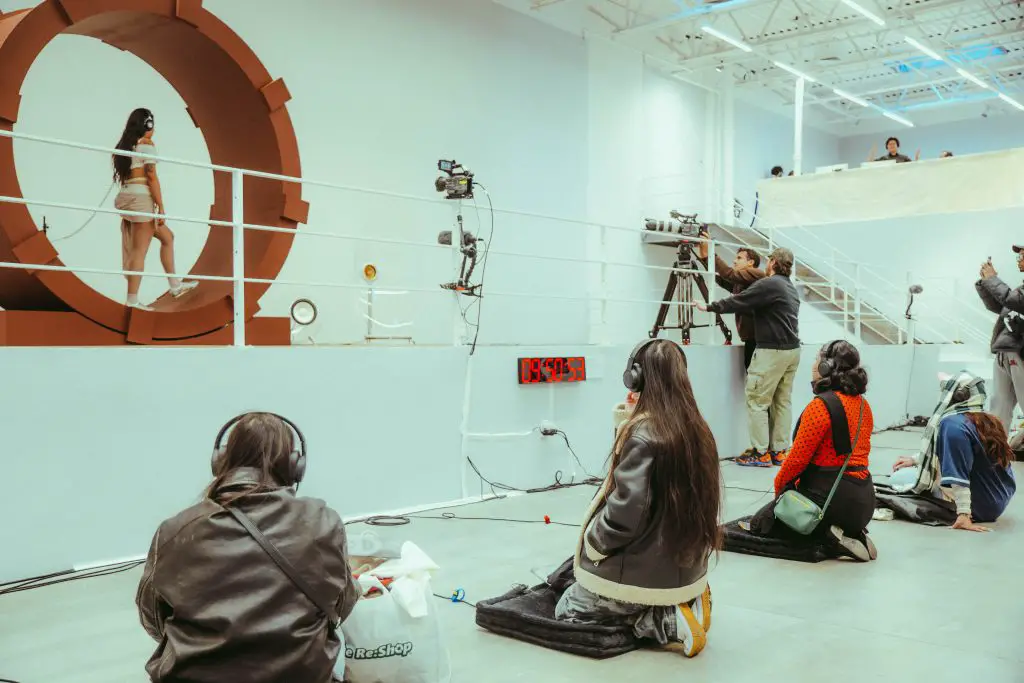
“The wheel’s supposed to be a representation of life being circular,” she explains, “and how you get older and realise that you’re just always doing the same thing on a different level. And you look down at your hands, and it’s like the same fucking scar from 10 years ago. Your family is just a bunch of versions of you.”
The wheel becomes a metaphor not just for career cycles, from debut all the way to reinvention, but for personal development. It’s that idea that evolution isn’t linear, that you revisit the same lessons with slightly more awareness each time. This is a philosophy that underpins ‘I Am’ – it’s an acceptance of complexity and an acknowledgement of what we collectively face. And that’s ultimately what Gates wants listeners to take from ‘I Am’: recognition. “I want them to feel understood,” she says. “Like they’re not alone in their experience.”
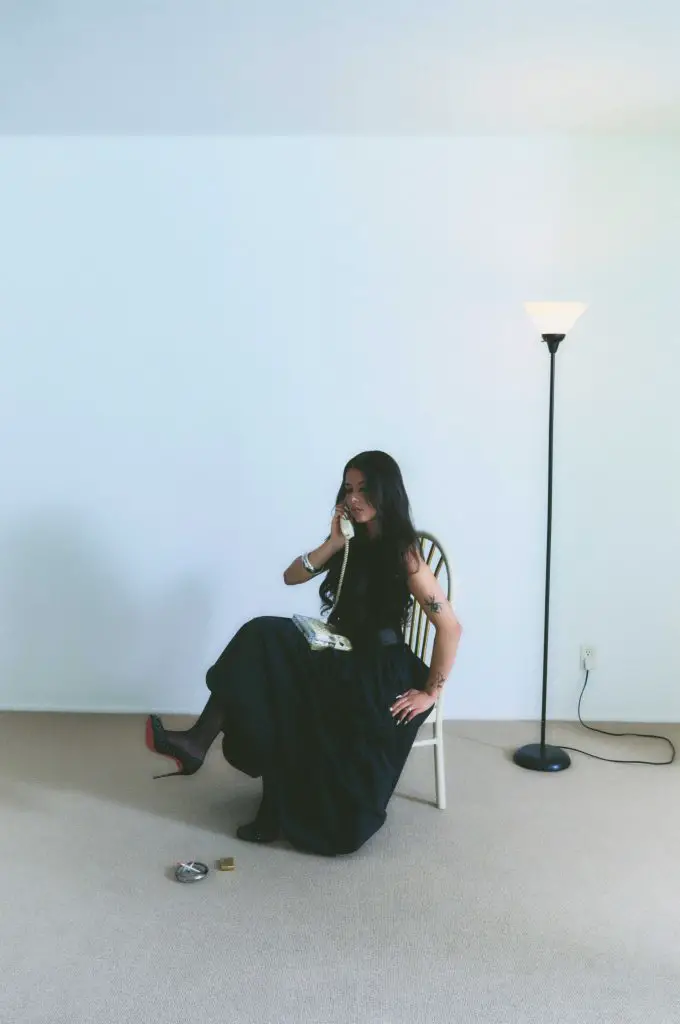
She’s acutely aware of the illusion of celebrity – the way people assume artists have life figured out, which in turn contributes to them feeling detached. Gates pushes back against that narrative, noting: “Everybody looks at these artists and thinks they’re better. But we’re all just navigating being human. And it’s fucking tough for everybody.”
Everybody looks at these artists and thinks they’re better. But we’re all just navigating being human. And it’s fucking tough for everybody.
Lexa Gates
It’s a sentiment that comes through unmistakably on ‘I Am’. On ‘I Don’t Even Know’, she raps “I’m usually by myself / Need help, there’s nothing wrong with me / Swear my shit don’t smell, I’m well off / Draped in luxury, haven’t been through hell”, while on the poignant and piano-led ‘Last Day’, her mind turns towards contemplation: “And everybody’s going through it in their own way / Hopefully, today’s better than the last day / ‘Cause everyday could be your last day”.
For Gates, it’s taken a lot of growth to arrive at this place, both sonic and psychological. “I think that I’ve grown a lot of confidence, which just comes from repetition and exposing yourself to things you’re afraid of,” she says. “I really don’t care anymore,” she says – clarifying that she means this positively. “This is what I do. I’m just doing my best.
“We’re all just a bunch of little kids pretending we know what we’re doing,” she continues. That realisation has been freeing because the stakes feel different when you understand that nobody, no matter how powerful, has total certainty.
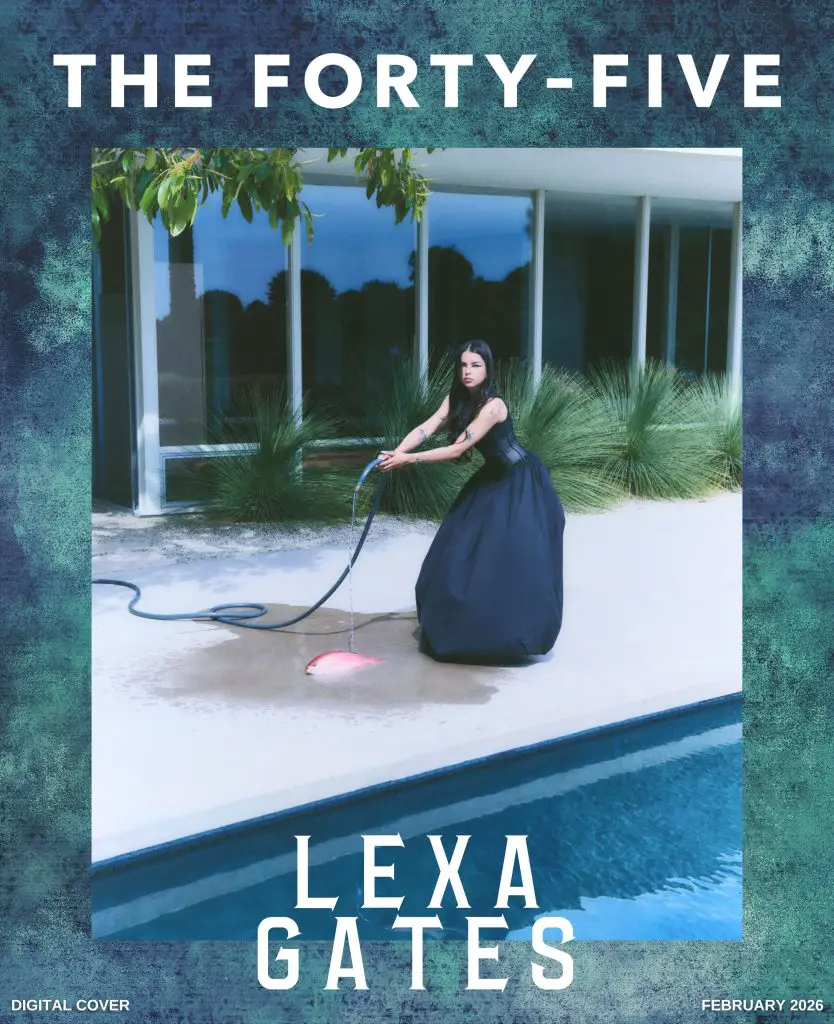
Despite the polish, the installations, the team behind her, Gates’ creative core remains remarkably consistent with the kid at the piano. She’s still experimenting, still allowing her unguarded self to pour out through the music, and still unsure which songs will resonate most until time has passed. There’s comfort in that uncertainty, but she’ll know for sure soon enough when she encounters audiences on her upcoming tour of North America, which leads nicely on to a European leg, including a stop at London’s KOKO on 23 June.
“At the end of the day, I always did this,” she says. “And I love it. I’m gonna just keep doing my art. I’m blessed. I have all the resources. I have a great team behind me. I have an audience and it’s what I truly, truly love to do. I still really respect the art of taking your time and creating with intention, loving what you do. I think that goes a long way.”
‘I Am’ isn’t presented as a definitive statement of identity; it’s a snapshot – a moment of self-definition in motion. For Gates, the album is less a declaration of arrival than a recognition of presence. Imperfect. Circular. Human.
‘I Am’ by Lexa Gates is out now.