

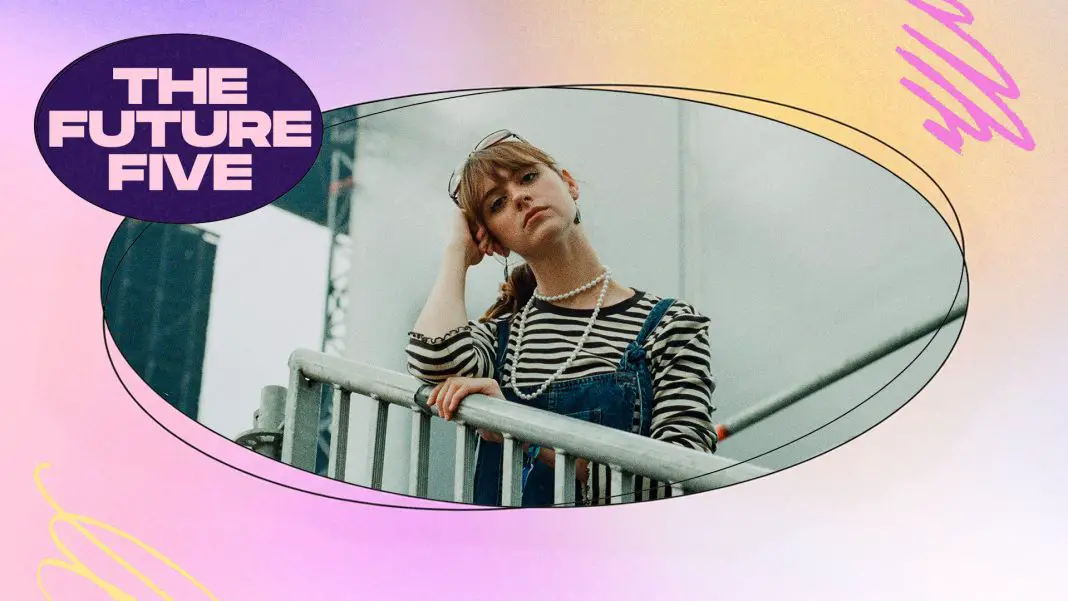
If the classic saying goes to put your money where your mouth is, then perhaps in the modern world it’s just as important to put your mouth where the money is. Such was the case at least for Chloe Slater, who wound up dropping last winter’s ‘War Crimes’ – a furious protest song about the failings of the current Labour government – just as she was about to embark on her most high-profile tour dates yet, supporting everyone’s favourite Sally-lover, Role Model. “I was actually a little bit scared because there were such massive audiences on the Role Model tour and none of them were my fans so I was like, I don’t know how everyone’s gonna take this…” she begins. “But it doesn’t matter because I wanted that song to hit as many people as possible. And no one booed, so it was good! The youth want a free Palestine, I think.”
‘War Crimes’, a brooding, angry slow burn steeped in Cure-esque guitar sounds and an earworm chorus that belies its rage, turns its gaze directly to the people averting theirs. “The reds turn to purples / It’s a sign of the times,” Slater begins. “They don’t see the landmines / They just reap the pearls.” It was written, she tells us, Zooming in from her bedroom in Manchester, following Keir Starmer’s appointment as Prime Minister.
“I personally had been wanting a Labour government for a really long time, and then you just saw this party that I thought represented socialist interests and the interests of the people sort of turn against those interests and become increasingly more centrist, especially in their stance over the genocide in Palestine,” she continues. “It was like seeing that party slowly become almost unrecognisable.”
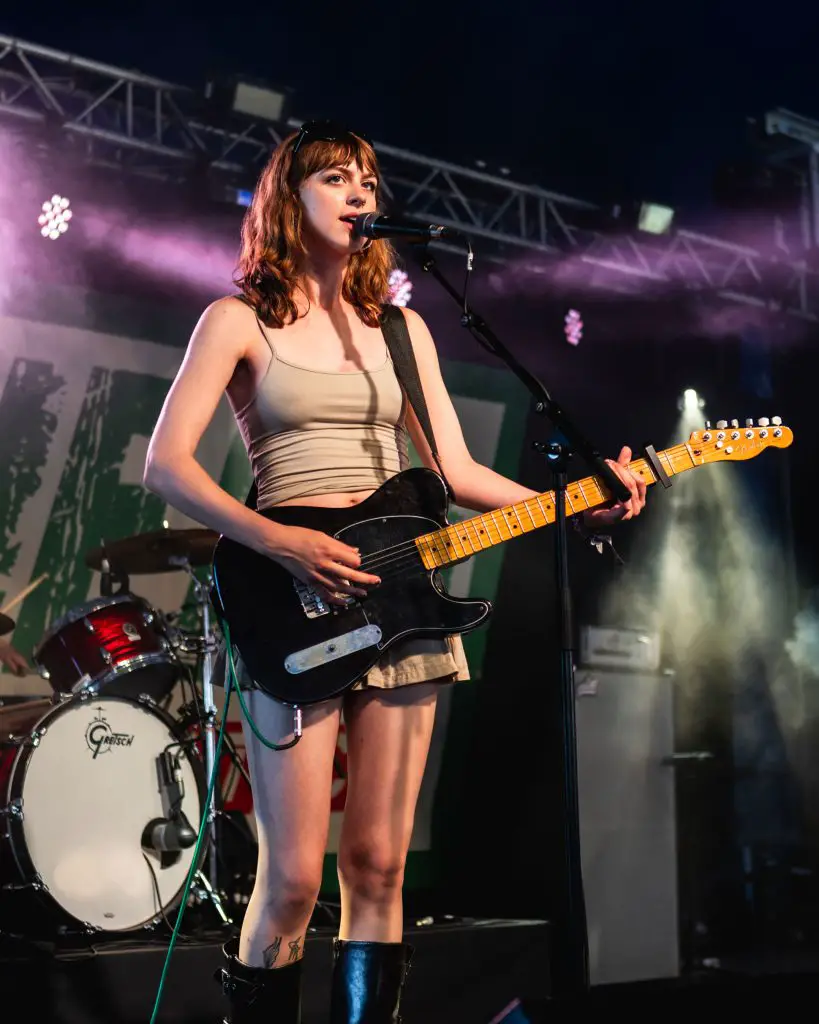
The track is undoubtedly Slater’s most outspoken, but it’s also indicative of the 22-year-old musician’s stance as a whole: she’s an artist with shit to say and the gumption to say it, no matter the risk or the potential admonishment of the algorithm. “I’m not claiming to be Bob Dylan or anything, but I like writing songs that start conversations and maybe change people’s opinions or help them look into things more because they’re curious,” she says. “What inspires me the most is people who have platforms – people who have something to lose, I guess – saying: ‘You know what? It’s worth it to do the right thing’.”
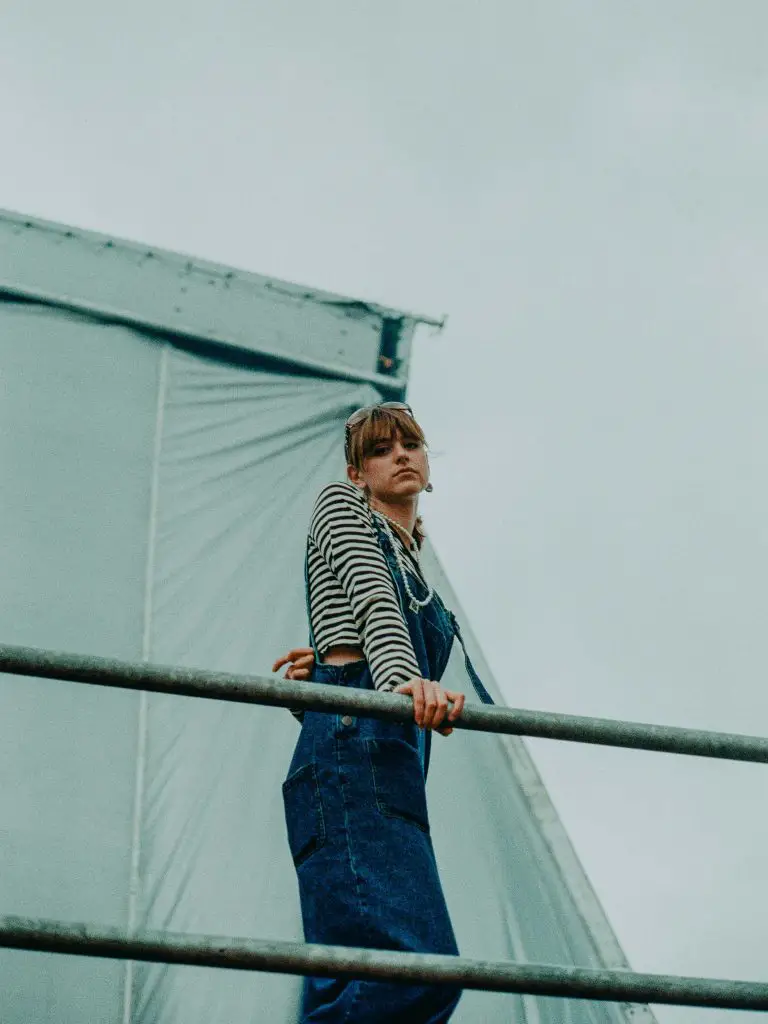
I’m not claiming to be Bob Dylan or anything, but I like writing songs that start conversations
Chloe Slater
Raised in Bournemouth, with little to no small-venue scene to speak of, it wasn’t a bustling musical landscape that nurtured Slater but a series of formative figures. In school, it was her music teacher and the after-school Band Academy club where she’d “go and play Arctic Monkeys songs with my friends, really badly on guitar”. At home, it was her inspirational single mother, who went back to University later in life and instilled in her the idea that nothing was impossible if you worked hard enough. “She was always very, like, ‘We can do whatever we want, and you can do whatever you want’,” she smiles. “Even though we didn’t necessarily have loads at that time, I felt very hopeful about my future.” On the airwaves, meanwhile, it was artists like Sam Fender and Declan McKenna – people bringing social commentary and political messaging to the mainstream, who showed that commercial success and sticking to your guns needn’t be anathema.
Wolf Alice, too, changed the game for a young Slater. “I got the first album [2015’s ‘My Love Is Cool’] on vinyl when I was a teenager, and I would listen to it non-stop,” she recalls. “It was one of those vinyls where there’s four different discs, so there’s a lot of flipping involved. So you’d sit down and listen to three songs, flip it over, three more songs… But there was something about that album that felt so relatable to me as a teenager that really wanted to move away. There’s a lot of themes of trying to figure out who you are, and wanting to leave home but feeling stuck. I just think Ellie Rowsell’s a really good role model for women that want to be doing rock music.”
Ellie Rowsell’s a really good role model for women that want to be doing rock music
Chloe Slater
Rowsell’s impact on the modern rock world is a lineage into which Slater is primed to follow – for a start off, she’s already been writing with the band’s drummer, Joel Amey. “That was quite scary, but he’s so nice. I just have this instilled fear of meeting famous people for some reason,” she grimaces. Has her path crossed with Fender yet? “No, no, no, I’m terrified of the concept of that ever happening. I literally have the lyrics to his song ‘Leave Fast’ tattooed on the back of my arm,” she replies, visibly baulking at the concept. “I enjoy the philosophy of ‘don’t meet your heroes’ but I feel like I keep getting thrust into situations now where I have to and I don’t like it…”
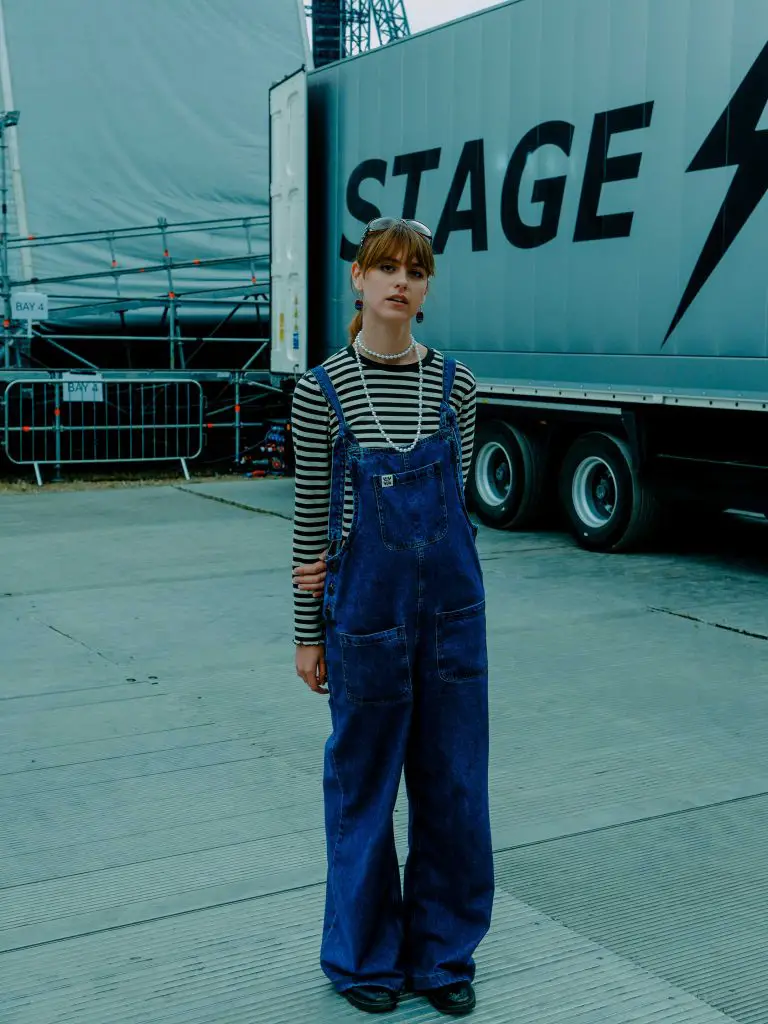
Slater had better start getting used to the circles she’s slowly beginning to roll in: following up 2024’s vibrant debut EP ‘You Can’t Put A Price On Fun’ with last year’s laser-sharp ’Love Me Please’, the momentum building around her feels real. It’s not just fandom of the intangible, online kind either. With songs like the latter EP’s ‘Tiny Screens’ – a wary treatise on the fickle nature of social media (“Get likes / Hit follow now / Don’t let me slip between the cracks”) – it’s obvious that Slater is an artist who doesn’t place too much importance on blindly trying to ‘do numbers’. She’s not a total naysayer. “I definitely do embrace it to a certain extent. My career kind of sprung off of social media so I owe it a lot,” she notes. “But I have found it quite damaging at times. A lot of people nowadays have a sort of love-hate relationship with their phones and with social media.
“I get pummeled with a lot of hate sometimes. It goes through phases, but it’s how you know you’re saying something right,” she continues. “I was seeing people just making up comments about me, like ‘This girl’s parents are famous music producers’. It’s just crazy how easy it is to spread lies. It’s always about women and it’s always the assumption that they didn’t get to where they are by themselves. I mean, I wish that I had rich parents that had helped me! If I had rich parents, I wouldn’t be doing this, I would just… be on the beach?!”
Let’s count our blessings, then, that Slater is not a secret nepo-baby. But while the dark side of the internet has already made its presence known, she’s also all too aware of the importance of online connection in a world that’s increasingly pricing her generation out of the real stuff. She’s set up various social groups for her fans to help bring them together in this way. “We have a community page and I have a WhatsApp group chat for everyone as well, so lots of people have made friends and now they come to my gigs together. We talk about what’s going on in the world and we try to make our differences in some way, but it’s not overwhelming,” she says. But outside of that bubble, things can often feel bleak.
“Sometimes it’s just really difficult as a young person now. Most people just can’t afford to do anything. Those social spaces that were so important to young people, like the pub or clubbing – just, like, going out – people can’t do that the way they used to and it’s really having a massive impact on people my age,” she says. “Everyone’s staying inside at home on their phone, and the phone is a new substitute for community, but people feel really lonely in that. It’s a scary time. I mean, I’m lucky because I’m doing my dream job for a living. But most 22-year-olds are coming out of Uni and they can’t get a job because there are no jobs.”
It’s just really difficult to be a young person now. Most people just can’t afford to do anything
Chloe Slater
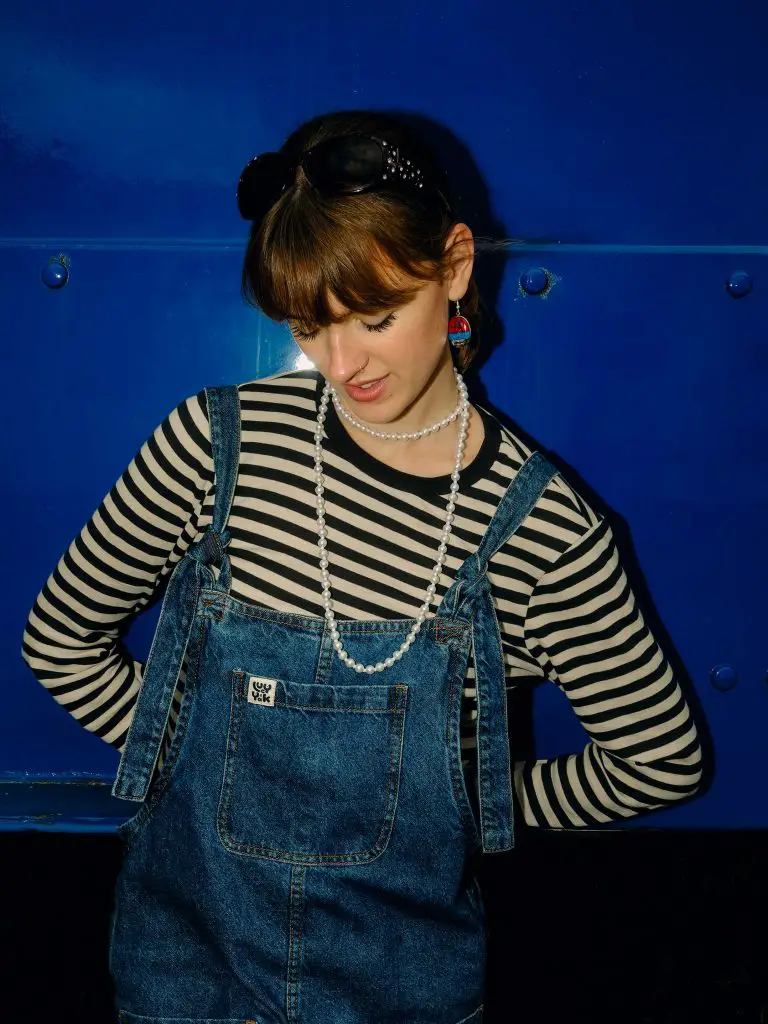
Really, then, is it any surprise that Slater’s songs are often angry and frequently frustrated? Tapped into the world and able to distil it via an eloquent pen, Slater is the sort of pop star we need right now: unafraid, socially conscious, but also – crucially – able to pen a proper banger. The latter, after all, is equally important. “I’m not just my political views. I want to be seen for the quality of my music besides that,” she notes.
She’s figured out a canny trick for reeling people in too, such as on live favourite ‘Fig Tree’, where the Sylvia Plath references of its title give way to a massive shout-along moment of Trainspotting-esque declarations: “Choose to age like a fine wine… Choose a life that is mine…” “My favorite thing about making music is referencing two or three things that are almost completely opposite and just putting them together. And everyone’s like, ‘Wow, this sounds so new and original.’ And I say, ‘Well, it’s actually just a combination of things you already love, but don’t realise!’” she laughs.
Slater’s also not averse to milking the unexpected wins the universe throws at her. After an endless string of comments noting her resemblance to Normal People lead Daisy Edgar-Jones, she did what any hustling star-on-the-rise would do and cast a Paul Mescal doppelganger to star opposite her in the video for ‘Harriet’. If you can’t beat them, join them. “She must think I’m such a weirdo if she’s seen me online,” Slater says. “Like, here’s this girl, why is she using me so much?!”
If Edgar-Jones has any sense, however, she’ll be flattered. If you’re going to have a musical mini me, you might as well make it one of the country’s most exciting, vital new talents. Kicking off 2026 with a purposefully open schedule designed to facilitate the writing of a project that she won’t be drawn into discussing but seems suspiciously album-shaped, all the groundwork is there for Slater to, as she jokes, “start taking the steps towards global superstardom”. She’s messing about, but really? We’d be lucky.
“I mean, it’s the classic, isn’t it: should pop stars say something or should they not?” she muses, debating the topic of what a musician in 2026 should stand for. “I don’t think everyone needs to start writing about politics; music is definitely an important place for escapism in some genres. However, there’s nothing to stop you sending a tweet out or posting something on your Instagram story or doing a charity gig. There definitely needs to be more activism from the people with big platforms.” She concludes with an idea that sums up her outlook as a whole: “I just think that sometimes a few words can make a big difference.”